HistoStain Hub
Special stain protocol - Laboratory reference
Periodic Acid-Schiff (PAS)
PAS - Periodic Acid Schiff
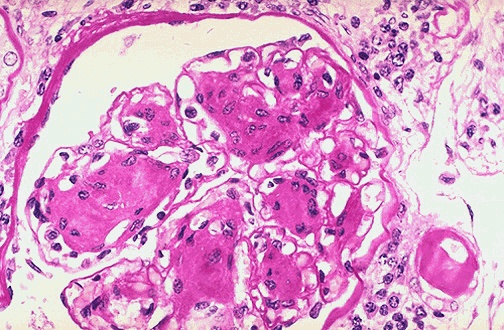
Diagnostic Use
Demonstrates glycogen, basement membranes, fungal walls, and neutral mucins. Used for renal glomerular basement membranes, fungi (Candida, Aspergillus), and glycogen storage disorders.
Principle
Periodic acid oxidizes vicinal glycols in polysaccharides to aldehydes. Schiff reagent forms a magenta complex with those aldehydes. Diastase digestion (PAS-D) removes glycogen for comparison.
Reagents
- Periodic acid, 0.5-1%
- Schiff reagent
- Hematoxylin counterstain
- Diastase/amylase (for PAS-D)
Control Tissue
Liver (glycogen), kidney (basement membranes), or fungal-positive tissue.
Method
- 1
Deparaffinize and hydrate sections to distilled water.
- 2
Oxidize in periodic acid for 5-10 minutes.
- 3
Rinse thoroughly in distilled water.
- 4
Immerse in Schiff reagent for 10-20 minutes, protected from light.
- 5
Wash in running tap water 5-10 minutes to develop color.
- 6
Counterstain lightly with hematoxylin; blue if required.
- 7
Dehydrate, clear, and mount.
Expected Results
| Target structure | Color | Background |
|---|---|---|
| Glycogen, neutral mucins, basement membranes | Magenta / pink-red | Blue (hematoxylin nuclei) |
| Fungal cell walls (Candida, Aspergillus) | Magenta | Blue nuclei |
Notes & Pitfalls
Pair with PAS-D when evaluating glycogen. Additional reference images: pas-candida.png, pas-glycogen.png.